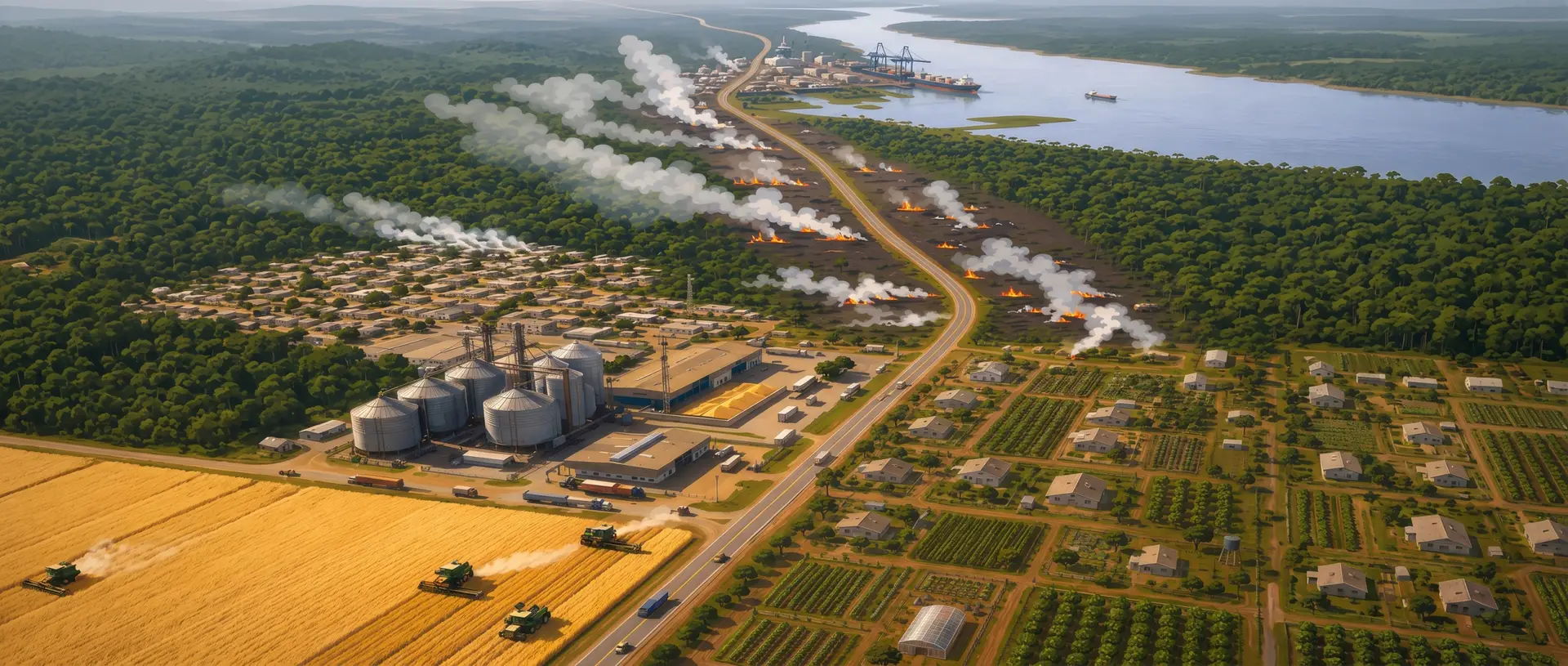
Brazil’s Legal Amazon has the potential to increase agricultural and livestock production without clearing additional forest. That is the main finding of a new study, “Agriculture in the Legal Amazon: Productivity Conditions, Climate Risks and Proposals for Better Production in Already Cleared Areas”, by Paulo Barreto, Ritaumaria Pereira and Gabriel Salles Barreto, published by Amazônia 2030.
The study finds that the region’s main agricultural challenge is not a shortage of land, but low productivity across much of the land that has already been cleared. At the same time, farmers are facing increasingly difficult conditions, including more frequent droughts, wildfires and other extreme weather events, as well as stricter environmental requirements for access to agricultural credit and international markets.
According to the authors, these challenges can be addressed without expanding the agricultural frontier. Experiences from across the Amazon show that when farmers have access to research, technical assistance, credit, infrastructure, storage and markets, they can achieve productivity levels comparable to those seen in Brazil’s most productive agricultural regions. Grain production in Mato Grosso and gains in cassava productivity in Rondônia are examples of this potential.
Yet most farmers in the Amazon still face major barriers to increasing productivity. Only 10% of farms in Brazil’s Northern region receive technical assistance, while just 9% of family farmers have access to agricultural credit. Long distances to consumer markets, inadequate logistics and difficulties accessing public procurement programs also constrain regional production.
The study also highlights the growing impact of climate change on agriculture in the Amazon. Between 2021 and 2024, agricultural losses across the Legal Amazon averaged nearly R$6 billion (about US$1.1 billion) a year. Prolonged droughts reduce yields and disrupt river transportation; floods hamper the transport and sale of agricultural products; and wildfires damage crops and pastures while affecting public health. Deforestation also reduces moisture recycling, lowers rainfall and increases climate risks for agriculture itself.
Environmental requirements are also playing an increasingly important role in the sector’s competitiveness. Restrictions on agricultural credit for properties with environmental violations, along with new international traceability requirements, are making it increasingly important to reconcile higher productivity with forest conservation. At the same time, studies indicate that much of the production growth expected in the coming years could come from land that has already been cleared, particularly through the recovery of degraded pastures.
Five recommendations for more productive and resilient agriculture
Based on the evidence, the study proposes five priorities for public policy and investment in the Legal Amazon:
establish stable funding for agricultural research, technical assistance and climate adaptation;
strengthen smallholder resilience through public procurement programs, technical assistance and local infrastructure;
prioritize infrastructure investments that lower production costs without encouraging further deforestation;
expand research on adapting Amazonian agriculture to climate risks; and
recognize intact forests as essential infrastructure for maintaining rainfall patterns, reducing climate risks and sustaining agricultural production.
The authors argue that strengthening agriculture in the Amazon depends less on creating new programs than on better coordination of policies and resources that already exist. Credit, research, technical assistance, infrastructure, public procurement and forest conservation can deliver stronger results when implemented together.
This integrated approach could increase productivity, raise farmers’ incomes, strengthen food security and reduce pressure to clear additional forest in the Amazon.